
Water management on board
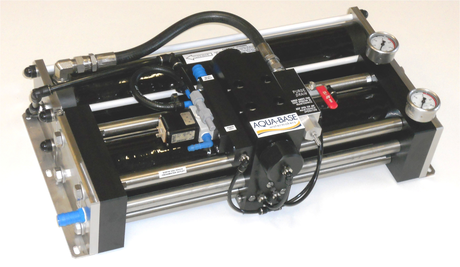
Apart from diesel for the engines, we hardly need to buy any other “liquids” to sustain ourselves on our boat. We can produce water—the most precious resource—ourselves, using a desalination system. This is what it looks like; it weighs about 30 kg and runs on 12 V. So when the sun is shining, solar power flows to the water generator, and it costs nothing. There’s no need for a generator that makes noise and guzzles diesel.
I'll explain how it works here: (click on the image to enlarge)
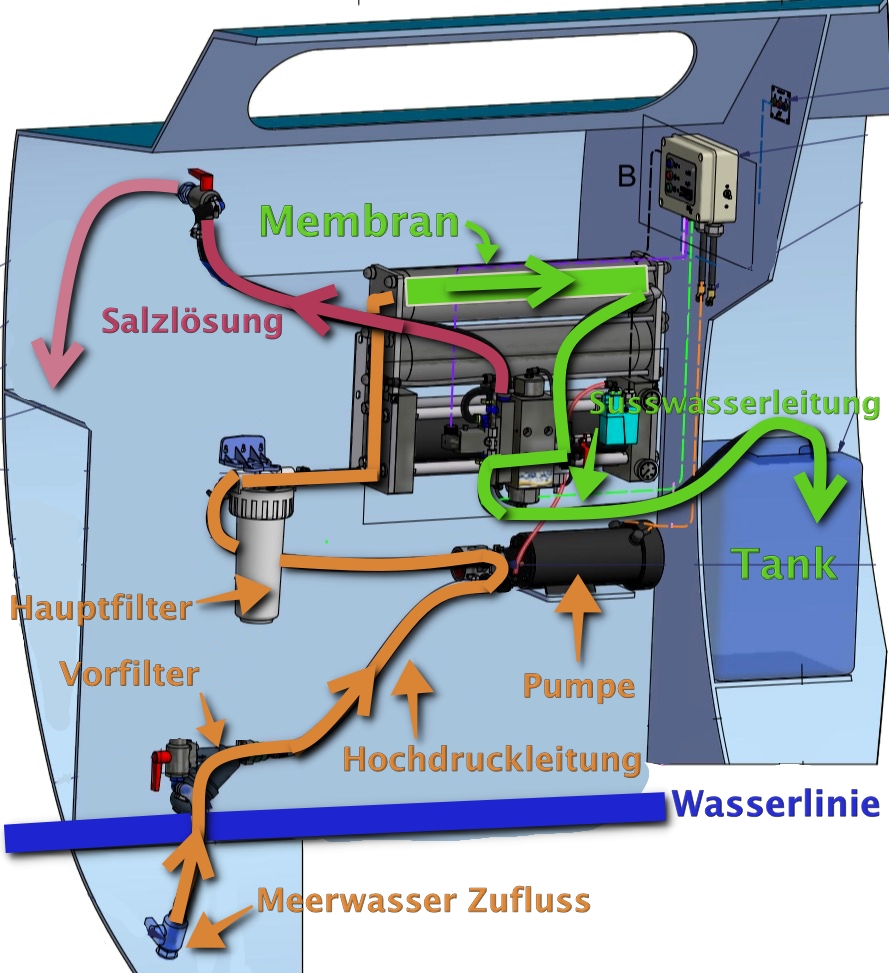
Seawater is drawn in at 220 psi by the Procon high-pressure pump (orange) and forced through two filters to the membrane. This is where reverse osmosis takes place. The osmotic membrane, which allows only the carrier fluid (water) to pass through while retaining the dissolved substances (salts and impurities), must be able to withstand these high pressures. When the pressure difference more than compensates for the osmotic gradient, the H₂O molecules pass through the membrane—much like they would through a filter—while the “contaminant molecules” are retained. Unlike a conventional membrane filter, osmosis membranes do not have continuous pores. Instead, the ions and molecules pass through the membrane by diffusing through the membrane material. Outside the membrane, the pure water and the salts are then separated and discharged. The water goes into the tank, and the salts, along with a small amount of rinse water, are returned to the sea. This allows us to produce 65 liters of fresh water per hour (in sunny weather, exclusively using solar energy, without the help of the diesel engine). Our tank has a capacity of over 500 liters, but is usually filled only halfway due to the extra weight and the ability to refill it at any time. We draw water from the tank for showering, washing dishes, cleaning the boat, and for our new washing machine.
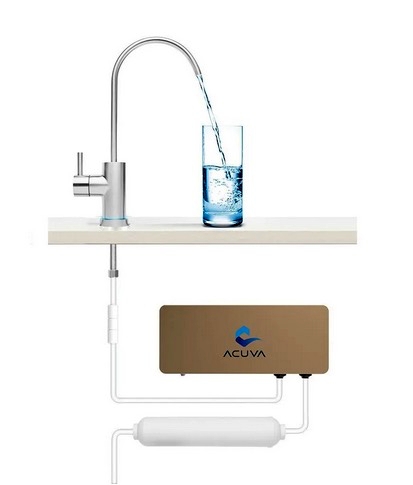
Das Trinkwasser muss noch eine spezielle UV-Behandlung durchmachen, indem es durch eine kleine Box mit einem Glasrohr fließt und dabei mit UV-LED-Licht bestrahlt wird.
Ein eigener Wasserhahn läßt keine Verwechslungen beim Wasserspenden zu.
Somit können 99,9 % aller Keime abgetötet werden. Ich habe dieses „ACUVA“ System seit 2019 und seit dieser Zeit hatte niemand an Bord je Keimprobleme.
Durch diese Methode erreichen wir eine 100 %ige Unabhängigkeit von Plastikflaschen. Sowohl beim Kauf als auch beim Entsorgen und haben in den entlegensten Gegenden Frischwasser.